Table of Content
Used for urination and sexual intercourse, the penis is made up of two erectile cylinders that enlarge with blood during erection. A tough fibrous, partially elastic outer casing surrounds the cavernosa. The corpus spongiosum surrounds the urethra , a tube that runs from the bladder to the end of the penis. If you have had an erection that has lasted more than two hours, you should go to the nearest emergency department for medical attention.

Early involvement of urologists when patients present to the emergency department. Priapism most commonly affects males in their 30s and older, but can begin in childhood for males with sickle cell disease. Medical News Today has strict sourcing guidelines and draws only from peer-reviewed studies, academic research institutions, and medical journals and associations. We link primary sources — including studies, scientific references, and statistics — within each article and also list them in the resources section at the bottom of our articles. You can learn more about how we ensure our content is accurate and current by reading our editorial policy. Diagnosing priapism usually starts with a detailed medical history and physical exam.
Intermittent (stuttering) priapism
Priapism can develop at any age in males usually in the age between 5-10 years or years, even in newborns. The blood gets trapped in the erection chambers of the penis and is not able to drain out. This pill helps men to maintain their erection level and cure erectile dysfunction and does not contain any side effects. It can be used by anyone who thinks he is having problem in achieving or maintaining erection. Even several types of medications or drugs can also lead to such problem like antipsychotics, blood thinners, and medications to get rid of ED, taking antidepressants, some kind of illegal drugs like ecstasy, crystal meth, cocaine etc. It is painful erection but not related to any sexual stimulation or desire.

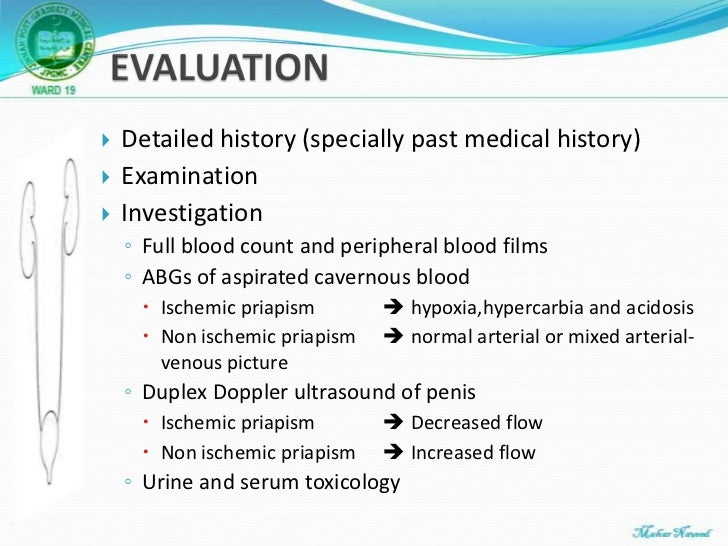
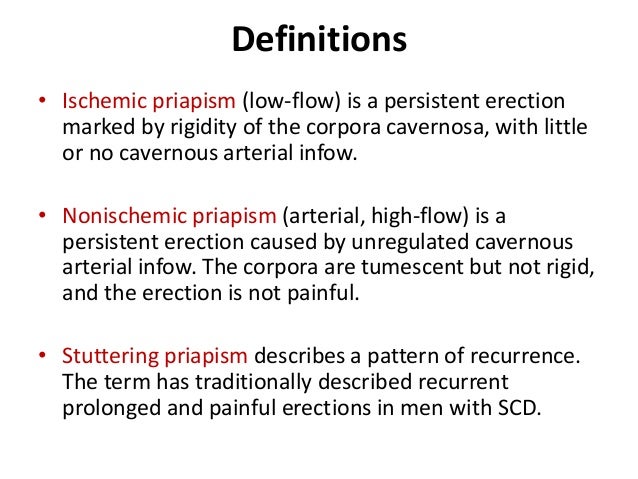
The Urology Care Foundation offers free, evidence-based patient education materials on urologic health to patients, healthcare providers, and the general public. From conditions to treatments to surgical devices and more, we've put everything you need to know about urology in one convenient place. There are two types of priapism, ischemic (low-flow) and nonischemic (high-flow), and treatment varies depending on the type, its severity, and the underlying cause. Diagnostic tests might be needed to determine what type of priapism you have. In an emergency room setting, your treatment will likely begin before all test results are received.
Prolonged Erection Following Intracavernosal Vasoactive Medication
The doctor will look at the genitals and groin to determine the pattern of rigidity and whether any trauma has occurred. Non-ischemic priapism is usually painless and causes an erection that is not fully rigid. The main symptom is a prolonged erection unrelated to sexual activity or interest. When starting any ICP therapy, it’s good practice to put together a ‘Rescue Kit” specifically for treating priapism. It takes some planning and communicating with your doctor, but it means being more prepared in the case of priapism. This is the opposite reaction of a vasodilator like Sildenafil, which dilates the blood vessels to allow more blood-flow to the penis.
In contemporary practice, prolonged erections often present in distinct ‘virtual’ clinical settings, including during telephone conversations, text messages, and other similar scenarios. Given the emergent nature of acute ischemic priapism, ICI with phenylephrine should begin as rapidly as possible following diagnosis. Specifically, intracavernosal treatments should not be delayed due to other systemic therapies (e.g., hydration, exchange transfusion), but may be administered concomitantly in most cases. When a decision must be made between systemic and intracavernosal treatments, intracavernosal therapy should take precedence in the majority of cases. They are suggested for patients who have low-flow priapism lasting more than 4 hours. These treatment options are less likely to be successful when duration of priapism lasts more than 72 hours.
What are the home remedies for priapism?
Membership of the Panel included specialists in urology and emergency medicine with specific expertise on this disorder. The mission of the panel was to develop recommendations that are analysis based or consensus-based, depending on panel processes and available data, for optimal clinical practices in the treatment of acute ischemic priapism. While these guidelines do not necessarily establish the standard of care, AUA seeks to recommend and to encourage compliance by practitioners with current best practices related to the condition being treated. As medical knowledge expands and technology advances, the guidelines will change. Today these evidence-based guidelines statements represent not absolute mandates but provisional proposals for treatment under the specific conditions described in each document. For all these reasons, the guidelines do not pre-empt physician judgment in individual cases.
In the majority of cases presently acutely to the emergency department, a corporal blood gas should be obtained during the initial evaluation to diagnose the priapism subtype. However, there are certain clinical situations where a blood gas may be omitted at the clinician’s discretion. Examples include priapism induced by in-office or at home ICI therapies, cases of recurrent ischemic priapism (i.e., SCD), or when the diagnosis is abundantly clear by history and examination alone. Criteria for inclusion and exclusion of studies was based on the Key Questions and the populations, interventions, comparators, outcomes, timing, and study designs of interest. Populations were male patients of any age with priapism secondary to sickle cell disease, with NIP, or with stuttering priapism; or adult males with a priapism episode following ICI. Stuttering priapism was defined as recurrent episodes Eligible study designs were RCTs, cohort studies, and case series with at least two patients.
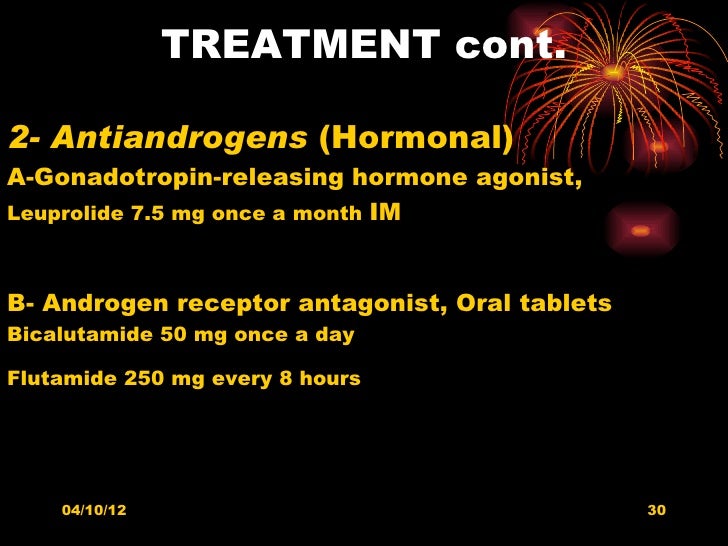
Spinal cord injuries or some direct trauma to penis or perineum can make you suffer from the above condition. Due to the lack of oxygen, there can be significant damage if it lasts for more than four hours. Comparative, prospective protocols for both acute ischemic and NIP management to better identify optimal management strategies.
"I joke with and I tell them, 'The erection is the property of Mayo Clinic. It's not yours and you're not going to leave my office with it,'" said Gregory Broderick, M.D., a urologist at Mayo Clinic in Jacksonville, Florida. "I advise all urologists and all physicians who run men's health clinics not to let the patient leave the office with the erection. Repeat steps 4-6 until detumescence is achieved or until the decision has been made to proceed with surgical shunting. Comparison of embolization techniques and materials, including short- and long-term outcomes including patient reported outcomes. Overall, the data on embolization outcomes are too limited to draw any firm conclusions on specific complication rates, or to provide guidance on the optimal method or material used with embolization. The data are sufficient to indicate that complications do occur in a percentage of individuals, including failure, ED, and recurrences.
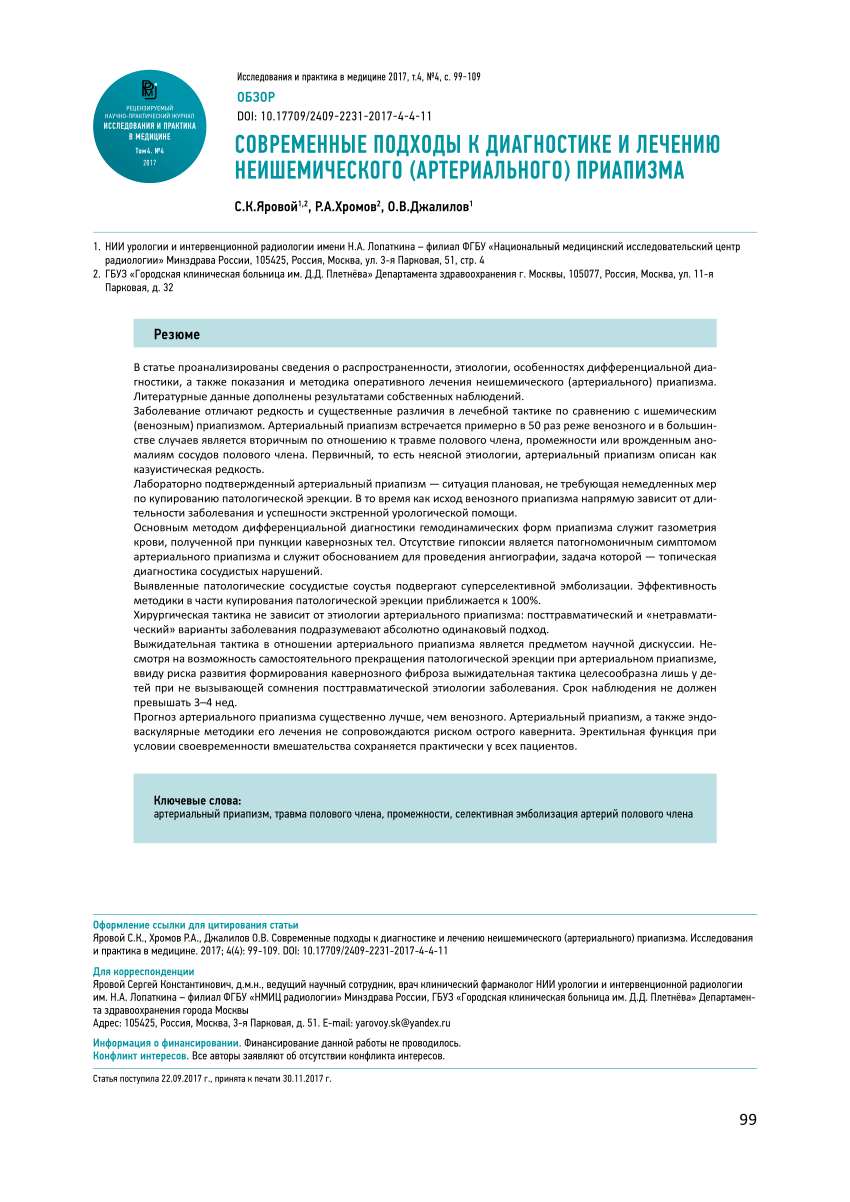
If the blood is bright red, it is probably non-ischemic priapism. There are three main types; Ischemic, recurrent, and non-ischemic. If you have any cardiovascular disease, be sure you tell your doctor before any treatment is performed. It’s rare, but priapism can happen because of cancers that affect the penis and prevent blood from flowing out of the area. Some treatments require blood work or additional documentation to provide a comprehensive health overview.
Above all, it does not pre-empt physician judgment in individual cases. Variations in patient subpopulations, physician experience, and available resources will necessarily influence choice of clinical strategy. Adherence to the recommendations presented in this document cannot assure a successful treatment outcome. The penis is composed of two chambers and a mass of spongy tissue .


No comments:
Post a Comment